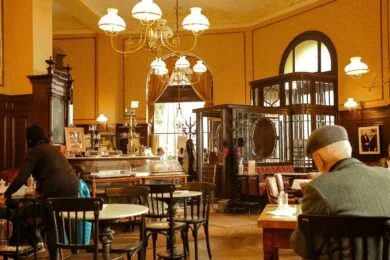

No place in the world has perfected the bond between coffee and culture quite like Vienna. Viennese coffee house culture was declared UNESCO Intangible Cultural Heritage in 2011, and rightly so. A Viennese coffee house is not a café. It's a living room, an office, a reading room, a meeting place and a philosophical salon all in one. You come in for a coffee and stay three hours. And that's exactly how it's meant to be.
The Coffee Menu: What to Order in Vienna
If you order "a coffee" in a Viennese coffee house, the best you can hope for is a pitying look from the waiter. Vienna has its own coffee language, and you should know it:
Kleiner Schwarzer – A simple espresso. Small, strong, black. The basis of everything.
Großer Schwarzer – A double espresso. For people who aren't morning people and those who slept in.
Kleiner Brauner – Espresso with a dash of milk or cream. The all-rounder.
Großer Brauner – The larger version of the Brauner. The classic standard order.
Wiener Melange – Vienna's answer to the cappuccino: an espresso with steamed milk and a cap of milk foam. The most popular order in every coffee house.
Einspänner – A double espresso in a glass with a generous cap of Schlagobers (whipped cream). The name comes from the one-horse Fiaker carriages: the coachmen could hold the glass in one hand.
Kapuziner – Similar to the Kleiner Brauner, but with whipped cream instead of milk. Darker and creamier.
Verlängerter – An espresso stretched with hot water. Milder than a Schwarzer, stronger than filter coffee.
Fiaker – A Großer Schwarzer with a shot of rum or kirsch and whipped cream. The upgrade for cold afternoons.
Maria Theresia – A Großer Schwarzer with orange liqueur and whipped cream. Decadent, sweet and imperial.
Coffee always comes with a glass of water, without you having to ask. It's part of the ritual and is refilled regularly. Leaving it out would be a crime against Viennese coffee culture.
The 10 Best Coffee Houses in Vienna
1. Café Central: The Legend
Café Central in Palais Ferstel is the most famous coffee house in the world, and not without reason. The high vaulted ceilings with marble columns, the piano music in the afternoon and the history that speaks from every corner make a visit an experience.
Leon Trotsky (who supposedly played chess here), Sigmund Freud, Arthur Schnitzler and Peter Altenberg all once sat here; a wax figure of Altenberg still greets you at the entrance today. The apple cake is legendary, the Melange excellent.
Good to know: Café Central is extremely popular. Your best chance of getting a table is on a weekday morning. On weekends, expect to wait 20–40 minutes.
Address: Herrengasse 14, 1010 Vienna
2. Café Sperl: The Authentic One
Café Sperl on Gumpendorfer Straße has remained practically unchanged since 1880. Worn velvet upholstery, billiard tables, newspapers on wooden holders and a waiter who knows full well that he doesn't need to hurry. The Sperl is the coffee house the Viennese go to when they want a real coffee house, not the one that's in every guidebook (although by now it's in there too).
What to order: Sperl-Torte, a house creation of chocolate and nougat that you'll only find here.
Address: Gumpendorfer Str. 11, 1060 Vienna
3. Café Hawelka: The Bohemian Legend
The Hawelka on Dorotheergasse is dark, cramped, smoky (well, it used to be) and packed with history. Founded in 1939, it became the meeting place of Vienna's art scene in the postwar years: painters, poets, musicians, they all sat here.
The interior has barely changed since. The Buchteln (Bohemian yeast buns filled with Powidl plum jam) are only served in the evening from 22:00, fresh from the oven. If you want to try them, you have to come late, and you'll be rewarded.
Address: Dorotheergasse 6, 1010 Vienna
4. Café Landtmann: The Political One
Directly opposite the Burgtheater and next to City Hall (Rathaus), the Landtmann is the coffee house of politicians, actors and journalists. People have debated, schemed and made decisions here, a tradition that continues to this day.
The interior is refined without being stiff, the kitchen is among the best of all Viennese coffee houses (the Wiener Schnitzel here is excellent), and in summer the Schanigarten (outdoor seating) on the Ringstrasse is one of the loveliest spots in the city.
Address: Universitätsring 4, 1010 Vienna
5. Café Prückel: The Insider Tip Among the Classics
On the Stubenring, overlooking the Stadtpark and the MAK (Museum of Applied Arts), the Prückel is a coffee house that has kept its 1950s charm. The furnishings, with curved booth seating and kidney-shaped tables, feel like a time capsule.
Especially worthwhile: the lower floor, where jazz and piano concerts take place regularly. The mood is intellectual, relaxed and wonderfully unpretentious.
Address: Stubenring 24, 1010 Vienna
6. Café Diglas: Cake Paradise
If you're looking for the best pastries in Vienna, there's no getting around the Diglas. The cake display is a work of art in itself: Topfenstrudel (strudel with a sweet curd cheese filling), Apfelstrudel, Sachertorte, Esterházy slices and dozens of other creations, all homemade.
The Diglas on Wollzeile is the traditional one; the newer Diglas am Fleischmarkt is a little more modern, but with the same quality of cake.
Address: Wollzeile 10, 1010 Vienna
7. Café Schwarzenberg: The Ringstrasse Classic
The oldest café on the Ringstrasse (since 1861) is on Schwarzenbergplatz and has preserved its grand café character over the decades. Large windows, crystal chandeliers and an atmosphere reminiscent of the Gründerzeit, Vienna's late-19th-century boom years.
The Schwarzenberg is less crowded than the Central or the Landtmann, and its Melange is one of the best in the city. There's regularly live piano music in the evening.
Address: Kärntner Ring 17, 1010 Vienna
8. Vollpension: Grandma and Grandpa Bake
A coffee house with a difference: at Vollpension, senior citizens bake from their own family recipes. Every cake has a story, every grandma a recipe that has been handed down for generations. The concept is social (it fights loneliness in old age) and convincing in culinary terms too.
The atmosphere is warm and welcoming, and the cakes change daily and are an experience every time. There are locations on Schleifmühlgasse (near the Naschmarkt) and in the MQ.
Address: Schleifmühlgasse 16, 1040 Vienna
9. Café Jelinek: The Anti-Café
The Jelinek on Otto-Bauer-Gasse is the opposite of a showcase coffee house: unvarnished, unrenovated and uncompromisingly Viennese. There are no tourists here, no menu with an English translation and no frills. Instead you get the most honest coffee, the grumpiest waiters and an atmosphere that sums up "Wien ist anders" (Vienna is different).
Address: Otto-Bauer-Gasse 5, 1060 Vienna
10. Café Korb: Art in the Basement
Founded in 1904, the Korb on Brandstätte is a cozy coffee house during the day, with strong Melange and a good breakfast. But the special part is in the basement: the Galerie im Korb shows changing exhibitions of contemporary art and is home to a legendary pinball machine that is a cultural artifact in its own right.
Address: Brandstätte 9, 1010 Vienna
Why Is the Waiter So Grumpy?
This may be the most common question from first-time visitors to Vienna. The answer: he isn't grumpy, he's professionally reserved. The Viennese coffee house waiter (traditionally addressed as "Herr Ober") doesn't see himself as a service provider in the modern sense, but as the guardian of an institution. He knows his guests, knows what they drink before they order and respects their privacy, which means he leaves them alone.
What looks like rudeness is actually the opposite of being pushy. Nobody asks every five minutes whether everything is still all right. Nobody brings the check without being asked. You'll be served when you're ready, and how you're served also depends on whether you know the unwritten rules.
Tip: A friendly "Grüß Gott" (hello) when you come in and "Zahlen bitte" (the check, please) with eye contact work every time. Never snap your fingers or wave.
The Unwritten Rules of the Viennese Coffee House
Stay as long as you like. There's no need for a guilty conscience; that's the whole principle. One coffee entitles you to stay for hours.
Reading the newspaper is part of it. Traditional coffee houses have newspaper racks with daily and weekly papers on wooden holders. Taking a paper and reading for an hour is not just allowed but encouraged.
Don't refuse the glass of water. It's part of the service and signals that you're respected as a guest.
Coming alone is completely normal. The coffee house is a place for company, but just as much for chosen solitude. Nobody will find it strange if you sit at a table on your own.
No laptop ban, but use some tact. In most traditional coffee houses, it's more stylish to open a book than a laptop. In more modern takes on the coffee house, such as Vollpension or Café Korb, working on a laptop is no problem.
Coffee House vs. Third-Wave Café: What Else Vienna Has to Offer
Alongside its traditional coffee houses, Vienna has developed a lively specialty coffee scene in recent years. If you're looking for single-origin beans, pour-over and latte art, you'll find them here:
Jonas Reindl (Westbahnstraße) – Named after the Viennese nickname for the Schottentor traffic circle. First-class filter coffee in a minimalist setting.
Kaffeefabrik (Favoritenstraße) – Its own roastery, a scientific approach to coffee and an outstanding flat white.
CoffeePirates (Spitalgasse) – One of Vienna's first third-wave roasters and still one of the best.
Kaffemik (Zollergasse in the 7th district) – Tiny and personal, with one of the best espresso machines in the city.
The difference from a traditional coffee house? In a specialty café, it's all about the coffee itself: origin, roast, brewing method. In a coffee house, it's about everything around it: the atmosphere, the time, the cake, the newspaper, seeing and being seen. Both have their place, and both are part of the Viennese coffee experience.
You'll find more culinary experiences in the Markets, Coffee Houses & Food category, or discover all attractions in Vienna.