
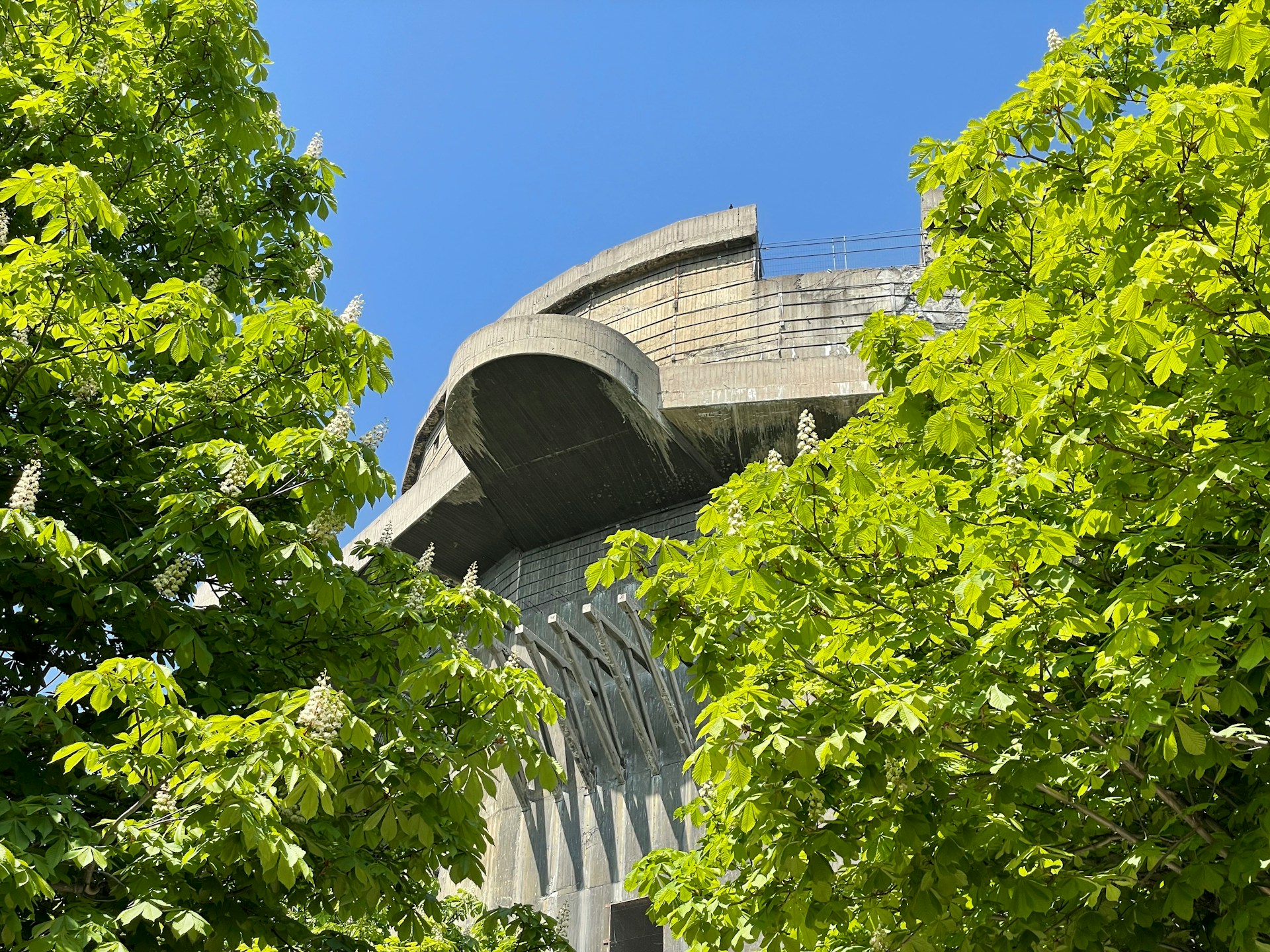
Two concrete towers from World War II stand in the Augarten park. If you plan to visit, you should know: you cannot go inside. There is no visitor entrance, no exhibition and no regular tours. A visit means standing in front of them, taking in their scale and walking through the park. That sounds like little, yet it is one of the most striking places in Vienna.
The gun tower has a footprint of 43 by 43 meters and is 55 meters tall. The walls are 2.5 meters thick, the roof 3.5 meters. These numbers mean little until you stand in front of it. The tower rises so far above the Baroque garden that you can see it from half of the 2nd district (Leopoldstadt).
The contrast is the real reason to come: a 17th-century Baroque garden, tree-lined avenues, lawns, people picnicking – and in the middle of it all a block of concrete that cannot be removed. That is exactly what gives it its power as a memorial. A walk around both towers takes about half an hour; if you include the park, allow an hour and a half.
If you want to see a flak tower from the inside, head to the 6th district: the fire-control tower in Esterházypark houses the Haus des Meeres aquarium.
The Augarten is open to the public free of charge, and since the towers cannot be entered anyway, there is nothing to pay.
The park's opening hours vary by season, and it closes much earlier in winter than in summer. The towers stand in the open and can be seen at any time while the park is open.
Late afternoon is best for photos: the sun is low and to the side, and the formwork marks in the concrete stand out. In winter, when the trees are bare, the tower looks bigger because nothing hides it. In summer it partly disappears behind the leaves.
Take the U2 to Taborstraße, then walk about ten minutes. Alternatively, take tram 2 or 31 to near Obere Augartenstraße. The park has several entrances; from the Obere Augartenstraße entrance you see the gun tower right away.
You don't need a car, and no driving is allowed in the park anyway. By bike, the route along the Danube Canal is a pleasant ride.
Vienna has three pairs of flak towers: in Arenbergpark, at the Stiftskaserne in Esterházypark and in the Augarten. They were always built in pairs – a gun tower with the anti-aircraft guns and a fire-control tower for target detection.
The Augarten pair is designated Tower Pair VII and belongs to the third construction type (Bauart 3). It was built between July 1944 and January 1945, making it the last of the three Viennese pairs. The lower floors were open to people seeking shelter.
In 1946 the gun tower was damaged by an accidental explosion of ammunition inside. Both towers have been unused ever since. Demolition is hardly an option because of the way they were built and their location in the park.
Other Viennese flak towers have found new uses: the fire-control tower in Esterházypark houses the Haus des Meeres, and the gun tower in Arenbergpark serves as a storage depot for the MAK (Museum of Applied Arts). The associated fire-control tower there is used for occasional exhibitions and tours. In the Augarten, by contrast, no use has been found to this day.
The three Viennese pairs were built one after another: first Arenbergpark from December 1942, then the Stiftskaserne from October 1943, and finally the Augarten. If you want to see all six towers, you get an unusual city tour through three districts – and the construction types show how the design changed over the course of the war.
Look for the fire-control tower. Almost everyone only notices the massive gun tower and overlooks the second, slimmer building. Only together does the system make sense: one fired, the other told it where to aim. The two stand so far apart that you rarely get both in one picture.
No. Both towers are unused and closed to visitors. There is no entrance, no exhibition and no regular tours. A visit means looking at the towers from outside and walking through the Augarten. If you want to experience a flak tower from the inside, the Haus des Meeres is in the fire-control tower in Esterházypark in the 6th district.
The gun tower has a footprint of 43 by 43 meters and is 55 meters tall. The walls are 2.5 meters thick and the roof measures 3.5 meters. These dimensions explain why demolition was never seriously pursued: the effort would be enormous, and the tower stands in the middle of a protected historic Baroque garden.
Between July 1944 and January 1945. That makes the Augarten pair the last of the three Viennese pairs – the others are in Arenbergpark and at Esterházypark. They were always built in pairs: a gun tower for the anti-aircraft guns and a fire-control tower for target detection. The Augarten pair is designated Tower Pair VII, construction type 3.
Because of the way it was built. With walls 2.5 meters thick and a roof 3.5 meters thick, blowing it up in the middle of a protected historic park would hardly be justifiable. In 1946 an accidental ammunition explosion inside caused further damage to the gun tower. It has stood unused ever since – and that is precisely what makes it work as a memorial.
Take the U2 to Taborstraße and walk about ten minutes from there. Alternatively, take tram 2 or 31 to near Obere Augartenstraße. The park has several entrances; from the Obere Augartenstraße entrance you see the gun tower right away. You don't need a car, and by bike the route along the Danube Canal is pleasant.
Half an hour is enough for a walk around both towers. If you include the Augarten – and you should, because the contrast is what makes the impact – allow an hour and a half. The park is big enough for a longer walk, and on its edge is the MuTh, the concert hall of the Vienna Boys' Choir.
No additional photos available.
Places nearby, sorted by distance from Augarten Flak Tower.

Am Augartenspitz 1, 1020 Vienna

Berggasse 19, 1090 Vienna

Praterstraße 54, 1020 Vienna

Franz-Josefs-Kai 29, 1010 Vienna

Gisela-Werbezirk-Promenade, 1020 Vienna
Blog posts related to this place.

The Belvedere is actually three museums and a garden. We explain where Klimt's The Kiss hangs, which ticket you need and...

Schönbrunn has changed its tickets: instead of the Imperial and Grand Tours, there are now three palace tours and severa...

Opera in Vienna doesn't have to be expensive: there are 435 standing places every evening, most of them for €13 to €18....