
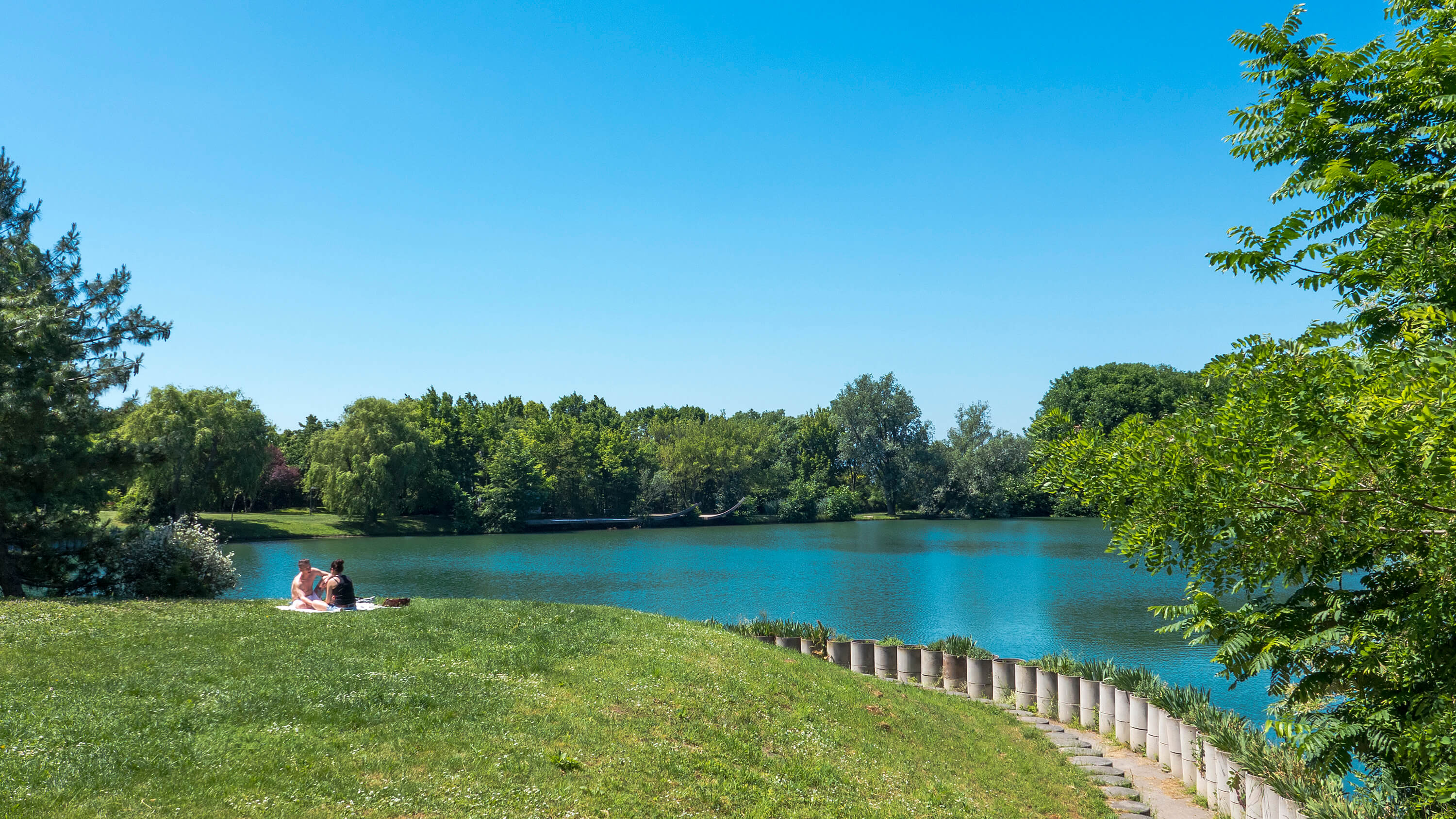
At around 608,600 square meters, Kurpark Oberlaa is one of Vienna's largest green spaces and lies on the southern edge of the city. It's not a park you pass through but one you stay in: theme gardens, ponds, an animal enclosure and spacious play areas are spread across the gently rolling grounds. Admission is free, and since 2017 the U-Bahn (subway) has stopped practically at the entrance.
For an afternoon, yes, especially with children. The park has several themed areas that you can link up on a loop walk. The Rosenberg (rose hill) is planted with around 2,400 roses. The Takasaki Garden is a Japanese garden of about 600 square meters. The Allergy Garden is an information trail where you learn which plant flowers when, more useful than it sounds if you suffer from allergies yourself.
There are also eight named ponds and lakes, including the Swan Lake and the Water Lily Pond, as well as an animal enclosure with goats and sheep. Other areas include the Baroque Fountain Garden, the Flower Labyrinth, the Perennial Garden and the Garden of Love.
If you're only looking for a quick sight, this isn't the place. The park has no single photo motif to tick off; its appeal is its sheer size.
Entry is free, all year round and for all areas of the park. You only pay if you visit the neighboring thermal spa or stop at one of the restaurants or cafés.
The park opens at 06:00 all year. Closing time changes with the season and, depending on the month, is between 18:00 and 22:00, so considerably later in summer than in winter. Check the current hours before an evening visit.
The best time depends on what you want to see. The Rosenberg is in bloom in June and again in a second flowering in September. The Japanese garden is at its most striking in fall, when the leaves change color. For families, late morning is a good time, as the play areas aren't crowded yet. On hot summer days, the open lawns make the park less shady than, say, the Prater.
Take the U1 to the Oberlaa terminus. The station opened on September 2, 2017, and is right by the entrance to Therme Wien (Vienna's thermal spa); the Kurpark adjoins it to the north. The ride from Stephansplatz takes about 20 minutes.
You can drive, but it rarely makes sense: the U-Bahn stops at the entrance, and you save yourself the search for parking. Dogs are allowed in the park but must be kept on a leash.
The park was created for the Vienna International Garden Show of 1974. The model was the 1964 garden show in Donaupark, which was considered a hit with the public, so the city decided on a second edition. The site chosen was a former brickworks on the southeastern slope of the Laaer Berg, enlarged through additional land purchases.
The 1974 garden show drew 2.6 million visitors. Unlike many exhibition grounds, the site remained a public park afterward, which explains the theme gardens that would never have come about in an ordinary green space.
The sloping terrain is a legacy of the brickworks: where clay was once dug, there are now meadows with a noticeable gradient. For strollers and wheelchairs this means not every path is equally comfortable, but the main paths are paved throughout. From the higher part of the park the view stretches across southern Vienna.
The Kurpark is on the outskirts of the city, so the nearest places in our guide are correspondingly farther away:
Don't enter at the main entrance by the thermal spa if the Rosenberg is your goal. From the U-Bahn it's at the opposite end, and you'll walk across the entire park. If you're heading specifically for the theme gardens, use one of the northern entrances instead, or plan the walk as part of your visit and deliberately go through the park lengthwise once.
No, entry is free and possible all year round, for all areas of the park, including the theme gardens and play areas. You only pay if you visit the neighboring Therme Wien thermal spa or stop at a restaurant or café. The park opens at 06:00 all year; closing time varies by season.
Take the U1 to the Oberlaa terminus. The station opened on September 2, 2017, and is right by the entrance to Therme Wien; the Kurpark adjoins it to the north. The ride from Stephansplatz takes about 20 minutes. You can drive, but it rarely makes sense because the U-Bahn stops practically at the entrance.
The Rosenberg (rose hill) with around 2,400 roses, the Takasaki Garden, a Japanese garden of about 600 square meters, and the Allergy Garden, an information trail. There are also the Baroque Fountain Garden, the Flower Labyrinth, the Perennial Garden and the Garden of Love. Eight named ponds and lakes are spread across the grounds as well, including the Swan Lake and the Water Lily Pond.
Yes, that's one of its strengths. There are playgrounds with water play, a climbing wall, a ten-meter-long swing, a beach volleyball court, a skate park, chess and game tables, table football and table tennis. One playground is wheelchair accessible. There's also an animal enclosure with goats and sheep.
For the Vienna International Garden Show of 1974. The model was the 1964 garden show in Donaupark, which was considered a hit with the public. The site chosen was a former brickworks on the southeastern slope of the Laaer Berg. The show drew 2.6 million visitors, and the site remained a public park afterward, hence the many theme gardens.
Yes, dogs are allowed but must be kept on a leash in Kurpark Oberlaa. This applies to the entire grounds. Because the park is very large, at about 60 hectares, with many paths, it's great for long walks despite the leash rule; unlike in smaller parks, you can cover a good distance here.
No additional photos available.
Places nearby, sorted by distance from Kurpark Oberlaa.

Simmeringer Hauptstraße 234, 1110 Vienna

Arsenal 1, 1030 Vienna

Arsenalstraße 1/21er Haus, 1030 Vienna

Guglgasse 6, 1110 Vienna

Landgutgasse 1, 1100 Vienna
Blog posts related to this place.

Leash or muzzle, which parks are off-limits, what your dog pays on the U-Bahn and where it can swim: everything for your...