
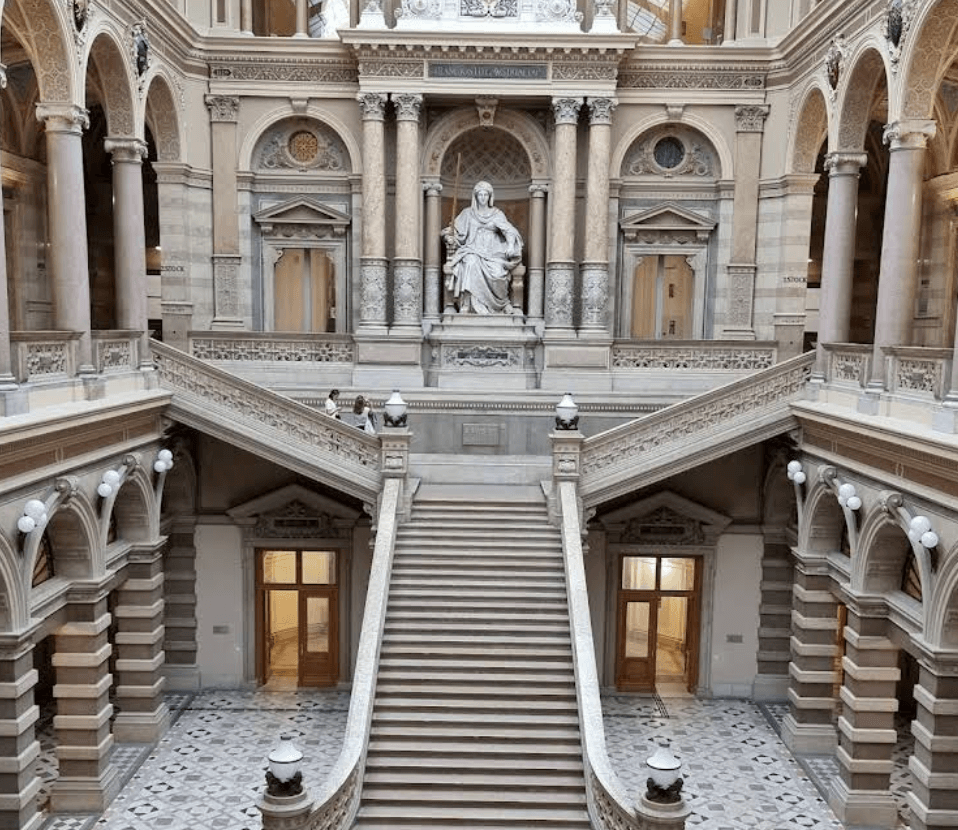
The Palace of Justice is not a museum but a working courthouse. It houses the Supreme Court, the Vienna Higher Regional Court, the Regional Court for Civil Matters, the Office of the Prosecutor General and the Senior Public Prosecutor's Office – more than 500 employees in all. Visitors are allowed, but there are no tickets, no tours and no museum operations. What there is: one of the most impressive halls in the city and a café on the top floor that hardly anyone knows about.
If you like historicist architecture: yes. The central hall is a three-story, glass-roofed arcaded hall, 31 meters long, 15 meters wide and 23 meters high. A broad grand staircase leads up to the second floor and ends at a marble statue of Justitia with a gilded sword and law book, created by Emanuel Pendl.
The appeal lies in the fact that this is a place of work. Lawyers wheel file carts up the staircase, and people wait in the corridors for their hearings. That is something different from a preserved state room – and it also means you should move around discreetly.
If, on the other hand, you expect a sight with a set route and signage, you will find little. There is no exhibition and there are no information panels. If you are interested in the period it was built, see the building in context: the Austrian Parliament, City Hall (Rathaus) and the University are a few hundred meters away and date from the same decades. The Ringstrasse era deliberately gave the institutions of the state their own buildings, each in a different historical style.
Allow half an hour for the hall and the same again for the café. If you combine both with the MuseumsQuartier or the Volksgarten, you have a good half day.
Admission is free. At the entrance there is an airport-style security check, with bag scanners and a metal detector. Bring a photo ID.
The building is open on weekdays, but not on weekends or public holidays. Core hours run from the morning into the early afternoon; exact times can change, so check beforehand if in doubt.
Midday is the best time for the hall: the sun is then high enough for light to fall through the glass roof onto the staircase. For the rooftop café the opposite applies – there you want a window table, and you are most likely to get one outside the lunch break.
The nearest U-Bahn (subway) station is Volkstheater (U2 and U3), about five minutes' walk away via Museumsplatz. Alternatively, the trams along the Ring stop nearby, as do lines 46 and 49 at the Ring. Coming by car is not worth it – the whole 1st district is a short-term parking zone.
The Palace of Justice was built between 1875 and 1881 to plans by Alexander Wielemans von Monteforte, in the Neo-Renaissance style. It is one of the buildings of the Ringstrasse era meant to give the institutions of the state a visible presence – alongside the Parliament, City Hall and the University.
On July 15, 1927, the building became the scene of one of the gravest events of the First Republic. After the acquittal in the so-called Schattendorf trial, a demonstration marched to the Palace of Justice, stormed the upper floors and set them on fire. The police fired into the crowd. 89 people died, 84 demonstrators and five police officers. The Palace of Justice fire is considered one of the milestones on the road to the civil war of 1934.
In 2007 the attic was converted. This created a central library that spans the hall as a "reading bridge" (Lesebrücke), and the public café directly above the main entrance.
Go into the hall first and then up to the café, not the other way around. From the grand staircase you see the arcades at their full height; if you have been upstairs first, you hardly notice them on the way down. And in the café, sit on the outer side: the view goes over the rooftops of the city center, not into the courtyard.
Yes, you can go in on weekdays free of charge. But it is a working courthouse, not a museum: there are no tours, no exhibition and no information panels. There is an airport-style security check at the entrance, so bring a photo ID and expect a short wait.
Yes. When the attic was converted in 2007, a public café was created directly above the main entrance. From there the view stretches over the rooftops of the city center. You have to pass the same security check as all other visitors. Because hardly anyone knows about it, it is rarely full even at peak times – you can usually get a window table.
On July 15, 1927, after an acquittal in the Schattendorf trial, a demonstration marched to the Palace of Justice, stormed the upper floors and set them on fire. The police fired into the crowd. 89 people were killed, 84 demonstrators and five police officers. The event is considered one of the milestones on the road to the Austrian civil war of 1934.
The Supreme Court, the Vienna Higher Regional Court, the Vienna Regional Court for Civil Matters, the Office of the Prosecutor General and the Vienna Senior Public Prosecutor's Office. Together more than 500 people work there. That also explains the character of the building: people wait in the corridors for hearings, and lawyers wheel file carts up the grand staircase.
The nearest U-Bahn (subway) station is Volkstheater, served by the U2 and U3. From there it is about five minutes on foot via Museumsplatz to Schmerlingplatz. The trams along the Ringstrasse also stop nearby. Coming by car is not worth it, because the entire 1st district is a short-term parking zone.
Between 1875 and 1881, to plans by Alexander Wielemans von Monteforte, in the Neo-Renaissance style. It is one of the Ringstrasse-era buildings meant to give the institutions of the state a visible presence – alongside the Parliament, City Hall and the University. The attic floor was added in 2007, along with the library and the public café.
No additional photos available.
Places nearby, sorted by distance from Palace of Justice (Justizpalast).

Arthur-Schnitzler-Platz 1, 1070 Vienna

Dr. Karl Renner-Ring 3, 1017 Vienna

Maria-Theresien-Platz, 1010 Vienna

Museumsplatz 1, 1070 Vienna

Maria-Theresien-Platz, 1010 Vienna
Blog posts related to this place.

The Belvedere is actually three museums and a garden. We explain where Klimt's The Kiss hangs, which ticket you need and...

Schönbrunn has changed its tickets: instead of the Imperial and Grand Tours, there are now three palace tours and severa...

Opera in Vienna doesn't have to be expensive: there are 435 standing places every evening, most of them for €13 to €18....